
Sizing a large solar project means moving constantly between two units. One megawatt equals 1,000 kilowatts, which is a million watts. Kilowatts describe homes and small commercial systems, while megawatts cover utility-scale arrays and grid-level production. The conversions themselves are simple: kW ÷ 1,000 = MW, and MW × 1,000 = kW. What trips people up is the difference between nameplate capacity and the energy a site genuinely delivers once peak sun hours enter the picture. Here is how to work through both sides of the calculation.
What “Output” Really Means for a Solar Installation
A watt measures the rate at which electricity is produced or consumed, rather than a total quantity. Think of it as speed rather than distance. A 6 kW array can produce 6,000 watts under ideal conditions, which is a very different statement from how much energy it actually generates across a year.
The Basic kW to MW Conversion Formula
Divide by a thousand and the job is done. A 10,000 kW installation simply becomes 10 MW. Travelling in the other direction, you multiply instead: a 1.32 MW site works out at 1,320 kW. Both directions rely on the same figure, so only the operation itself changes.
From Watts to Gigawatts at a Glance
| Kilowatts (kW) | Megawatts (MW) | Watts (W) |
|---|---|---|
| 1 kW | 0.001 MW | 1,000 W |
| 10 kW | 0.01 MW | 10,000 W |
| 100 kW | 0.1 MW | 100,000 W |
| 1,000 kW | 1 MW | 1,000,000 W |
| 10,000 kW | 10 MW | 10,000,000 W |
| 1,000,000 kW | 1,000 MW (1 GW) | 1,000,000,000 W |
A Step-by-Step Example Using a Real Solar Array
Picture a commercial rooftop carrying 2,400 kW of installed panels. Dividing by a thousand gives 2.4 MW of installed capacity. That single number is what appears in planning documents, grid applications and press releases, and it describes the system’s rated power rather than its real production.
How Peak Sun Hours Affect Your Actual MW Output
Capacity on its own tells you nothing about the energy actually delivered. Multiply the rated power by your region’s peak sun hours in order to estimate daily output. The same array performs very differently in a location receiving five peak sun hours compared with one receiving only three.
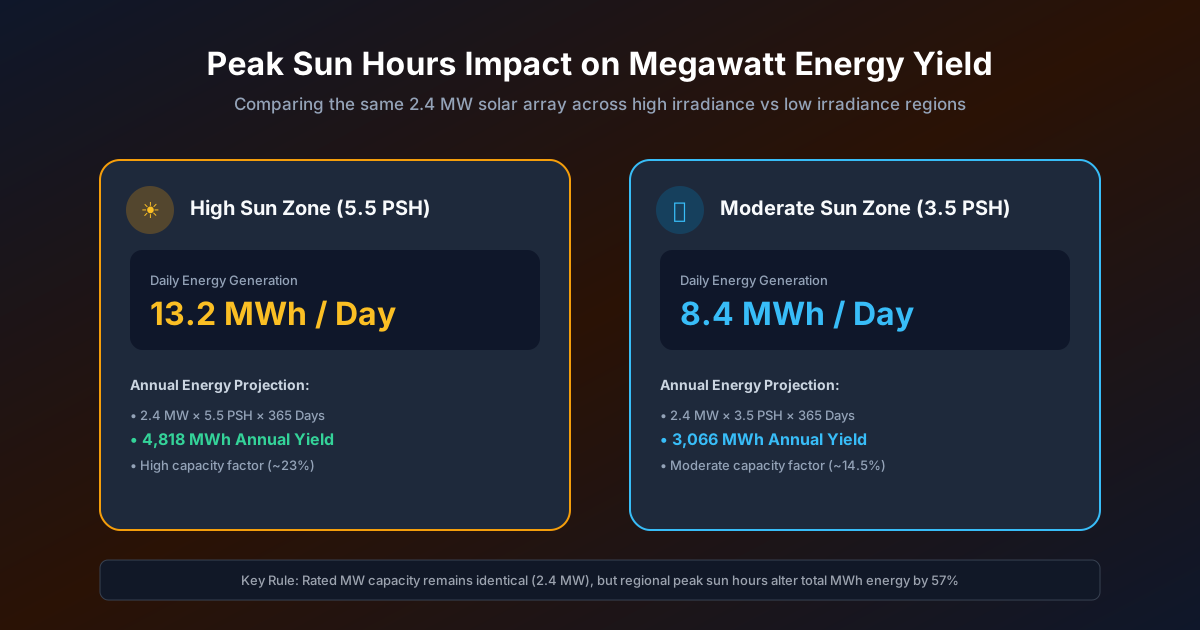
Nameplate Capacity vs Real-World Energy Production
Capacity is quoted in kW or MW; energy produced is quoted in kilowatt hours. A kilowatt describes power at a given moment, while a kilowatt hour describes power used across one hour. Mixing those two up is easily the most common error in solar reporting.
Calculating Output for Multi-Array Commercial Sites
Large sites rarely consist of one single block of panels. Total the capacity of every array in kilowatts first, then convert the combined figure once. Converting each array separately and adding afterwards invites rounding errors that quietly accumulate across a large installation.
How System Losses Reduce Your Final MW Figure
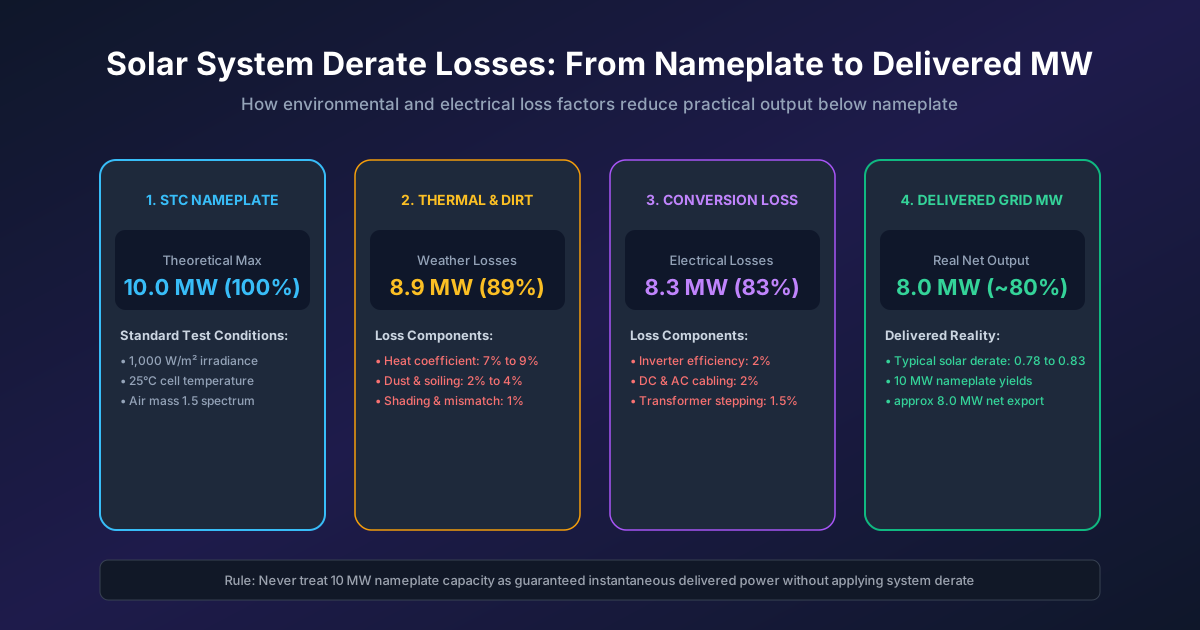
Rated output assumes ideal conditions that real sites never quite meet. Shading, heat, cable runs and inverter behaviour all reduce the delivered energy below that nameplate figure. Any realistic projection should therefore sit noticeably below the theoretical maximum you first calculated.
Comparing Residential, Commercial, and Utility-Scale Output
Residential systems generally run between 5 kW and 15 kW, while household HVAC equipment alone can draw roughly 1.5 to 4 kW. Commercial and utility-scale projects are measured in megawatts. At 1,000 MW, a gigawatt carries enough capacity to power roughly 173,000 homes.
Common Mistakes When Calculating High-Capacity Output
Confusing kW with kWh sits firmly at the top of the list. Close behind come misplaced decimals, since 0.1 MW and 0.01 MW look similar yet differ by a factor of ten. Treating nameplate capacity as guaranteed production is the third, and it tends to produce badly optimistic financial forecasts.
Tools and Formulas for Verifying Your Final Numbers
Check every figure by reversing it: multiply your megawatt answer by a thousand and confirm that you recover the original kilowatts. For home sizing, divide daily consumption by peak sun hours, so 30 kWh spread over five hours indicates roughly a 6 kW system.
Conclusion
Converting between these two units takes one factor and a clear head: divide kilowatts by a thousand to reach megawatts, then multiply to go back. The harder part is remembering that capacity and production are two different things, separated by peak sun hours and by real-world system losses. Total your arrays before converting, keep your power and energy figures firmly apart, and verify everything by simply reversing the calculation afterwards.
Need to convert electrical units right now?
Use our precision kW to MW, MW to GW, and kWh to MWh instant engineering calculators.