
One megawatt always equals 1,000 kilowatts, a fixed relationship set by the International System of Units that never changes regardless of industry or country. Converting kW to MW comes down to dividing by 1,000, while going the other direction means multiplying by 1,000, and the whole process takes three simple steps once you know which way to move the decimal. Solar quotes, utility bills, and power plant specs all lean on this exact math, yet plenty of people still flip the direction by accident. This guide breaks the conversion into three clean steps with real-world numbers from actual solar installations.
Why KW and MW Confusion Leads to Costly Errors
Moving the decimal the wrong direction is the single most common mistake people make, since kW to MW requires dividing and making the number smaller, which feels backward compared to most everyday math. Remembering that megawatt is always the smaller number for the same amount of power keeps the direction straight every time.
Understanding the Metric Relationship Between KW and MW
Electricity measurement follows the metric system exactly, so a kilowatt is 1,000 watts and a megawatt is 1,000 kilowatts, or one million watts total. This isn’t a solar industry shortcut, it’s the same International System of Units maintained by NIST that governs every metric prefix, with no rounding and no regional exceptions anywhere.
Step 1: Identify Your Starting KW Value
Before converting anything, confirm the exact kilowatt figure you’re working with, whether it comes from a solar quote, a spec sheet, or a utility bill. A typical rooftop solar system runs 5 to 15 kW, while a commercial or utility-scale solar farm starts measuring output in the thousands of kilowatts instead.
Step 2: Apply the Correct Division Factor
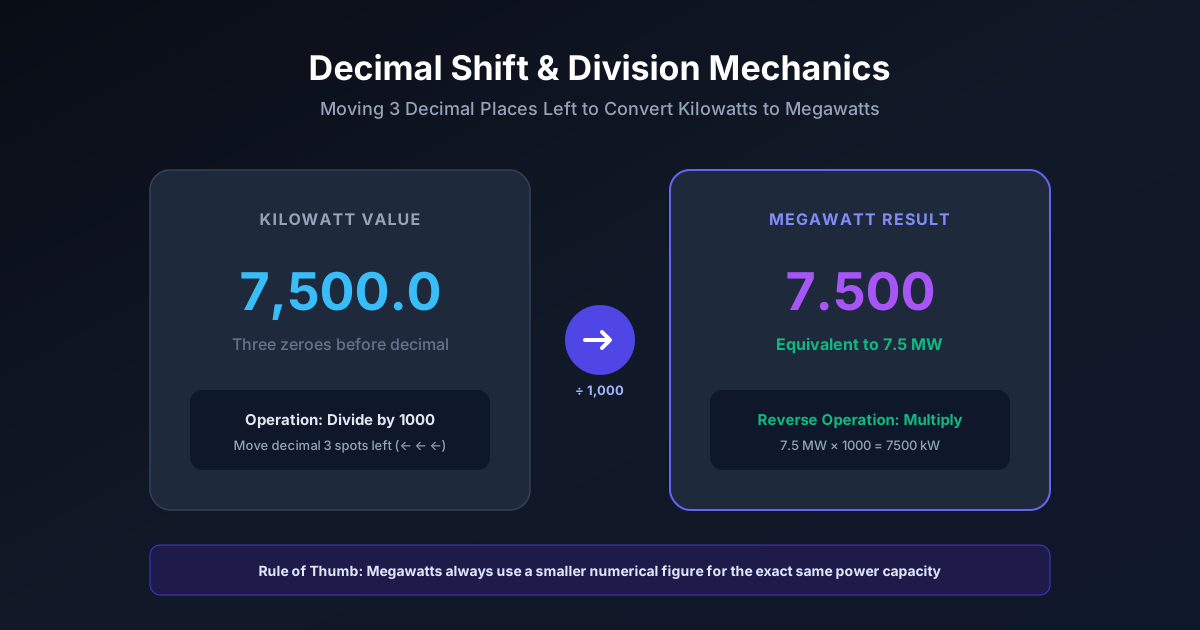
Once you have your starting kW value, divide it by 1,000 to reach megawatts, since MW equals kW divided by 1,000. For example, 5,000 kW divided by 1,000 equals 5 MW, and 7,500 kW divided by 1,000 equals 7.5 MW, following the exact same formula every single time.
| Input (kW) | Calculation | Result (MW) |
|---|---|---|
| 1,000 kW | 1,000 ÷ 1,000 | 1 MW |
| 5,000 kW | 5,000 ÷ 1,000 | 5 MW |
| 10,000 kW | 10,000 ÷ 1,000 | 10 MW |
| 100,000 kW | 100,000 ÷ 1,000 | 100 MW |
Step 3: Round and Verify Your MW Result
After dividing, double-check that your result makes sense relative to the scale you expect, since a typo can easily produce a number ten or a hundred times too large or small. A rooftop system should land well under 1 MW, while only commercial and utility-scale projects should produce results in the double or triple digits.
A Worked Example From a Real Power Plant
The Edwards & Sanborn Solar and Storage project in Kern County, California, has an installed capacity of 875 MW, equal to 875,000 kW. Converting that figure back confirms the math: 875,000 kW divided by 1,000 returns exactly 875 MW, matching the published utility-scale solar farm rating precisely.

Converting MW Back to KW the Reverse Way
Reversing the process simply means multiplying instead of dividing, so kW equals MW times 1,000. A 2.5 MW system converts to 2,500 kW, and a 50 MW facility converts to 50,000 kW, using the exact same relationship applied in the opposite direction.
Common Mistakes When Shifting the Decimal Point
Confusing kW with kWh trips up even experienced readers, since one measures a rate and the other measures a total amount of energy over time. Treating a megawatt capacity figure as an annual output is another frequent error, since a farm rated at 550 MW describes its nameplate capacity, not how much energy it actually produced over a year.
Where This Conversion Matters Most in Industry
Homeowners comparing a rooftop solar quote in kilowatts against a utility-scale project described in megawatts rely on this exact conversion to understand the real difference in scale. It would take roughly 58,000 to 175,000 individual home rooftop systems to match the output of a single 875 MW facility like Edwards & Sanborn.
Quick Reference Chart for Common KW to MW Values
Keeping a handful of common conversions memorized speeds up everyday math considerably: 500 kW equals 0.5 MW, 1,500 kW equals 1.5 MW, and 25,000 kW equals 25 MW. Bookmarking a full reference table remains useful for less common figures that don’t divide as cleanly in your head.
Conclusion
Converting kW to MW always follows the same three steps: identify your starting kilowatt value, divide by 1,000, then verify the result makes sense for the scale involved. The reverse direction simply multiplies by 1,000 instead, using that exact same fixed ratio. Whether you’re reading a rooftop solar quote, a utility bill, or comparing a full utility-scale power plant, this relationship never changes, rounds, or varies by region or industry.
Need to convert electrical units right now?
Use our precision kW to MW, MW to GW, and kWh to MWh instant engineering calculators.