
Kilowatts and megawatts describe the same thing, electrical power, at different scales, but the conversion trips people up constantly on solar quotes, utility bills, and spec sheets. The rule never changes: 1,000 kilowatts equal 1 megawatt, following the same metric prefixes used throughout the International System of Units. This guide walks through the formula, the direction people most often get backward, the classic kW-versus-kWh mix-up, and worked examples at the exact numbers people look up most.
1. What Kilowatts and Megawatts Actually Measure
A kilowatt and a megawatt both measure power, the rate electricity is produced or used at a given moment, not a total over time. A kilowatt equals 1,000 watts; a megawatt equals 1,000 kilowatts, or one million watts. Kilowatts describe home appliances and rooftop solar, typically 5 to 15 kW, while megawatts describe commercial and utility-scale systems.
2. The Conversion Factor: Why 1,000 kW Equals 1 MW
The base relationship never varies: 1 MW equals exactly 1,000 kW, defined by the International System of Units and maintained by NIST. There is no rounding and no regional variation. Every step up the power ladder, kilo to mega to giga, is exactly times 1,000, which is what makes the formulas below so mechanically simple.
| Conversion | Formula | Example |
|---|---|---|
| kW to MW | MW = kW ÷ 1,000 | 5,000 kW = 5 MW |
| MW to kW | kW = MW x 1,000 | 2.5 MW = 2,500 kW |
| kWh to MWh | MWh = kWh ÷ 1,000 | 9,855 kWh = 9.855 MWh |
3. Moving the Decimal Point: The Fastest Way to Convert
To convert kW to MW, divide by 1,000, moving the decimal three places left. A 5,000 kW system becomes 5 MW; a 100 kW system becomes 0.1 MW. To reverse the conversion, multiply by 1,000 and move the decimal three places right. Both directions use exactly the same ratio, just applied in opposite directions.
4. kW to MW vs. MW to kW: Which Direction Trips People Up
The most common error is moving the decimal the wrong way. Converting kW to MW makes the number smaller, since megawatts are the larger unit, but it’s easy to multiply out of habit instead of divide. A quick sanity check: if your converted figure got bigger when going from kW to MW, the direction was wrong.
5. Common Mistakes: Confusing kW with kWh
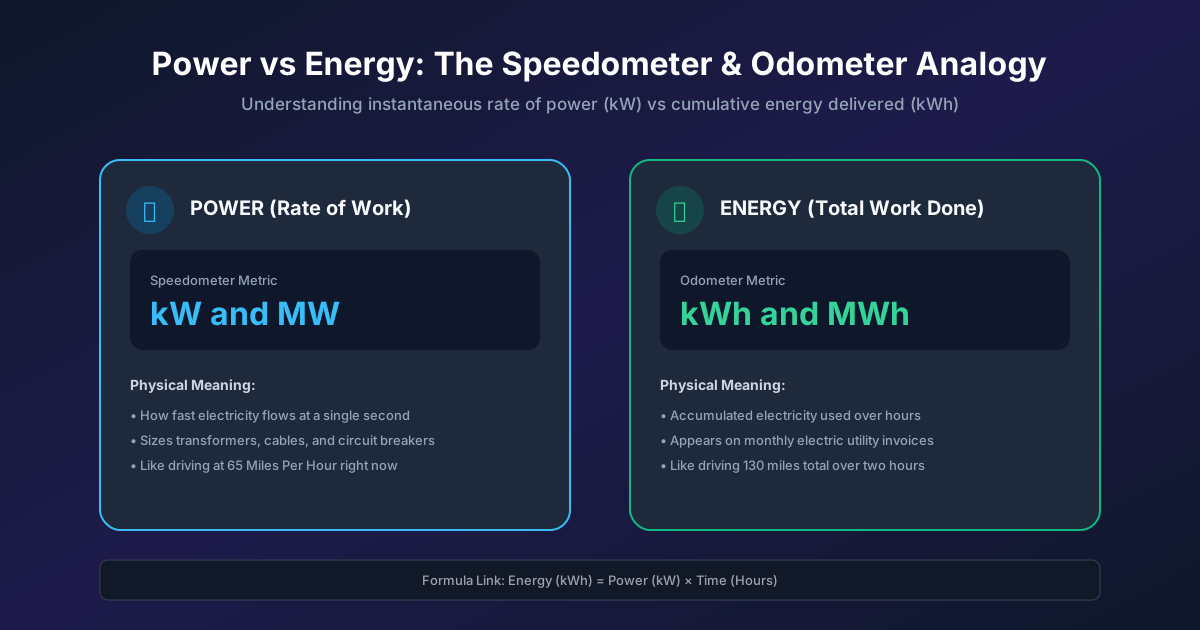
A kilowatt and a kilowatt-hour are not the same measurement, and this causes more confusion than the scale conversion itself. Power, in kW or MW, answers how fast electricity is flowing right now. Energy, in kWh or MWh, answers how much was used or produced over time. A utility bill charges for kWh, not kW, because it bills total energy delivered.
6. Where This Conversion Matters: Power Plants, Grids, and Solar Farms
Kilowatts size home appliances and rooftop solar, typically 5 to 15 kW for a household. Megawatts describe commercial projects, community solar, and utility-scale farms; a single 875 MW farm needs over 58,000 individual 15 kW rooftop systems to match its output. Gigawatts, in turn, describe state or national grid capacity.
7. Converting Mixed Units in a Single Calculation
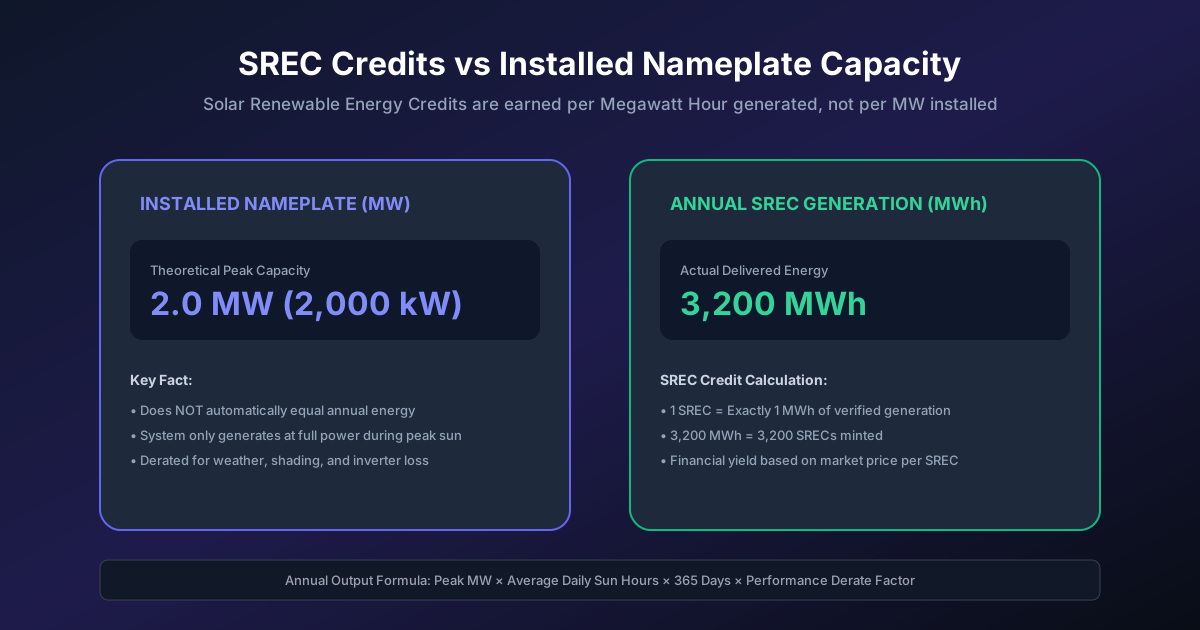
Solar Renewable Energy Credits are earned per megawatt-hour of energy produced, not per megawatt of capacity installed, and confusing a rate with a total throws estimates off by orders of magnitude. When a calculation mixes capacity, in kW or MW, with energy, in kWh or MWh, convert every figure to the same category before comparing numbers.
8. Rounding Errors That Multiply at Industrial Scale
At residential scale, rounding barely matters, but industrial figures compound fast. Treating a plant’s megawatt capacity, a nameplate rating, as if it were annual output in megawatt-hours can overstate real production by a factor of thousands, since capacity describes a rate while annual output depends on hours actually generating at that rate.
9. Worked Examples at Common Power Ratings
A 100 kW system converts to 0.1 MW, and 1,500 kW converts to 1.5 MW. Going the other way, 1.32 MW converts to 1,320 kW, and 25 MW converts to 25,000 kW. A 6 kW rooftop system producing 27 kWh a day adds up to roughly 9,855 kWh, or 9.855 MWh, across a year.
| Input | Direction | Result |
|---|---|---|
| 100 kW | ÷ 1,000 | 0.1 MW |
| 1,500 kW | ÷ 1,000 | 1.5 MW |
| 1.32 MW | x 1,000 | 1,320 kW |
| 25 MW | x 1,000 | 25,000 kW |
10. A Quick Mental Checklist to Avoid Mistakes
Before finalizing a kW-to-MW calculation, confirm three things: which direction you are converting, whether the figure measures power or energy, and whether you are comparing capacity against capacity or output against output. If a headline number sounds too large or small at a glance, re-check the decimal placement before trusting it.
Conclusion
Converting between kilowatts and megawatts always comes down to the same fixed ratio: divide by 1,000 to go from kW to MW, and multiply by 1,000 to reverse it. Most mistakes come from moving the decimal the wrong way or confusing power, kW and MW, with energy, kWh and MWh. Keep those two distinctions straight, double-check your decimal placement, and the math itself never gets any harder than third-grade arithmetic.
Need to convert electrical units right now?
Use our precision kW to MW, MW to GW, and kWh to MWh instant engineering calculators.