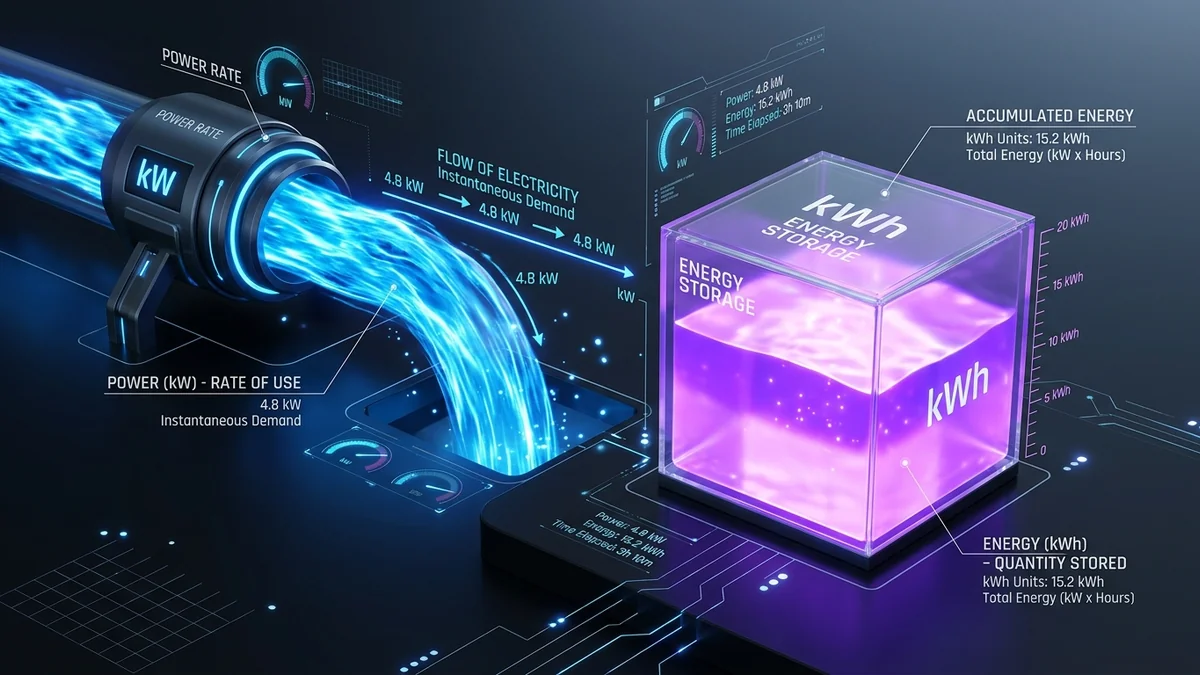
One of the most widespread points of confusion in electrical engineering, solar system sizing, and utility billing is the difference between Kilowatts (kW) and Kilowatt-hours (kWh).
Although they share the base unit “watt,” they measure two fundamentally different physical quantities:
- kW (Kilowatt) measures Power — the instantaneous rate of electricity generation or consumption.
- kWh (Kilowatt-hour) measures Energy — the total cumulative amount of work performed over a period of time.
Confusing power with energy can lead to incorrect generator sizing, improper battery storage capacity calculations, and miscalculated electrical utility bills.
The Core Physics & Mathematical Definitions
1. What is a Kilowatt (kW)?
A kilowatt represents the instantaneous rate at which electricity flows. It is derived directly from the SI unit of power, the Watt (W):
Everyday Analogy: A kilowatt is like the speedometer in an automobile. It indicates how fast energy is being consumed or produced at any single instant in time.
2. What is a Kilowatt-hour (kWh)?
A kilowatt-hour is a unit of accumulated energy. It measures the total quantity of electricity consumed or generated when one kilowatt of power is sustained continuously for one hour:
Everyday Analogy: A kilowatt-hour is like the odometer in your car. It measures the total cumulative distance traveled over your entire trip.
The Fundamental Mathematical Formula
Head-to-Head Comparison Table
| Parameter | Kilowatts (kW) | Kilowatt-hours (kWh) |
|---|---|---|
| Physical Quantity | Electrical Power () | Electrical Energy () |
| SI Base Equivalent | ||
| Instrument Reading | Wattmeter / Power Analyzer | Electric Utility Revenue Meter |
| System Sizing Application | Sizing wires, breakers, transformers, and inverter peak capacity | Sizing battery capacity, fuel reserves, and monthly energy budgets |
| Typical Billing Component | Demand Charges (\/\text{kW}$) | Consumption Charges (\/\text{kWh}$) |
4 Practical Real-World Calculation Scenarios
Scenario 1: Sizing an EV Home Charging Session
- Charger Power Rating: A Level 2 home charging station delivers 7.4 kW.
- Session Duration: The electric vehicle is plugged in overnight for 6.5 hours.
- Energy Consumed:
- Electricity Cost Calculation (at \0.16/\text{kWh}): $$\text{Cost} = 48.1\text{ kWh} \times \0.16 = $7.70$$
Scenario 2: Residential Solar PV Production
- Array Peak Rating: A residential rooftop solar array has a nameplate peak capacity of 8.0 kW.
- Peak Sun Hours: On a clear summer day, the system receives 5.5 effective full sun hours.
- Daily Energy Generation:
Scenario 3: Industrial Induction Motor Operation
- Motor Active Load: A factory air compressor draws 45 kW continuously during operational shifts.
- Operating Schedule: 16 hours per day, 25 days per month ().
- Monthly Energy Consumption:
Scenario 4: Battery Energy Storage System (BESS) Duration
- Battery Capacity: A residential backup battery stores 13.5 kWh of usable energy.
- Emergency Household Load: During a grid blackout, the essential home circuits draw an average power of 1.5 kW.
- Backup Runtime:
Common Misconceptions to Avoid
- Never say “kW per hour” ():
- Power is already a rate (Joules per second). Saying “kW per hour” is mathematically equivalent to saying “miles per hour per hour” (acceleration), which is meaningless when describing electricity usage.
- Confusing MW and MWh at Utility Scale:
- A power plant describes its maximum instantaneous capacity.
- If that plant runs for at full load, it generates of energy.
- Overlooking Standby Power Drain:
- Even low-power appliances () running consume significant cumulative energy:
Frequently Asked Questions (FAQ)
What is the simple rule to remember kW vs kWh?
kW is the rate of flow; kWh is the total volume delivered. Think of kW as water flow rate in gallons per minute, and kWh as the total gallons in a bucket.
How do I convert Watts to Kilowatt-hours?
Divide watts by to get kW, then multiply by the number of hours of operation. For example, a light bulb running for :
How do kW and kWh relate to MW and MWh?
and . Use our dedicated kWh to MWh Converter and kW to MW Converter for instant unit conversions.
Standards & References
- IEEE Std 1459: IEEE Standard Definitions for the Measurement of Electric Power Quantities Under Sinusoidal, Nonsinusoidal, Balanced, or Unbalanced Conditions.
- NIST SP 811: Guide for the Use of the International System of Units (SI).
- IEC 60050: International Electrotechnical Vocabulary (IEV) - Generation, transmission and distribution of electricity.
Need to convert electrical units right now?
Use our precision kW to MW, MW to GW, and kWh to MWh instant engineering calculators.