
Commercial power calculations often start in kilowatts (kW) and only later need converting to megawatts (MW) once a facility’s scale demands it.
Since 1 MW equals exactly 1,000 kW, the kW to MW conversion itself is simple arithmetic, yet knowing the right moment to switch units is what actually matters in practice.
Large-scale commercial power calculations rely on consistent unit reporting across load reports, utility billing statements, and engineering documentation.
Mixing up power units in electrical engineering can distort a demand charge calculation or a grid interconnection filing without anyone noticing right away.
This guide walks through industrial power consumption thresholds, commercial energy demand reporting, and the exact point where megawatt-scale reporting becomes the clearer standard.
By the end, you will know exactly when to apply the kilowatt to megawatt conversion formula in your own commercial and industrial power planning.
What Counts as “Large-Scale” in Commercial Power Terms
A facility generally earns the large-scale commercial power label once its peak electrical demand approaches or exceeds 1,000 kW. Below that point, kilowatts remain perfectly readable; above it, expressing facility load in MW avoids clunky four- and five-digit kilowatt figures that are harder to scan at a glance.
Why Small Commercial Systems Stay in KW
Retail stores, small offices, and restaurants typically draw loads well under 1,000 kW, so kilowatts stay intuitive for equipment sizing, utility bill calculations, and everyday comparisons between buildings of similar size, without forcing anyone to deal with decimals.
The Threshold Where MW Becomes the Practical Unit
Once demand crosses roughly 1 MW, continuing to report in kW produces numbers that are harder to scan at a glance. Switching to megawatt-scale reporting at this power consumption threshold keeps reports and dashboards readable for engineers and non-technical stakeholders alike.
Converting KW to MW for Load and Demand Calculations
The kilowatt to megawatt conversion formula is simple: divide kW by 1,000 to get MW, or multiply MW by 1,000 to get kW. Applying this consistently across a electrical load calculation avoids mismatched units creeping into the same report and makes totals easy to double-check by hand.
How Utility Billing and Demand Charges Use MW
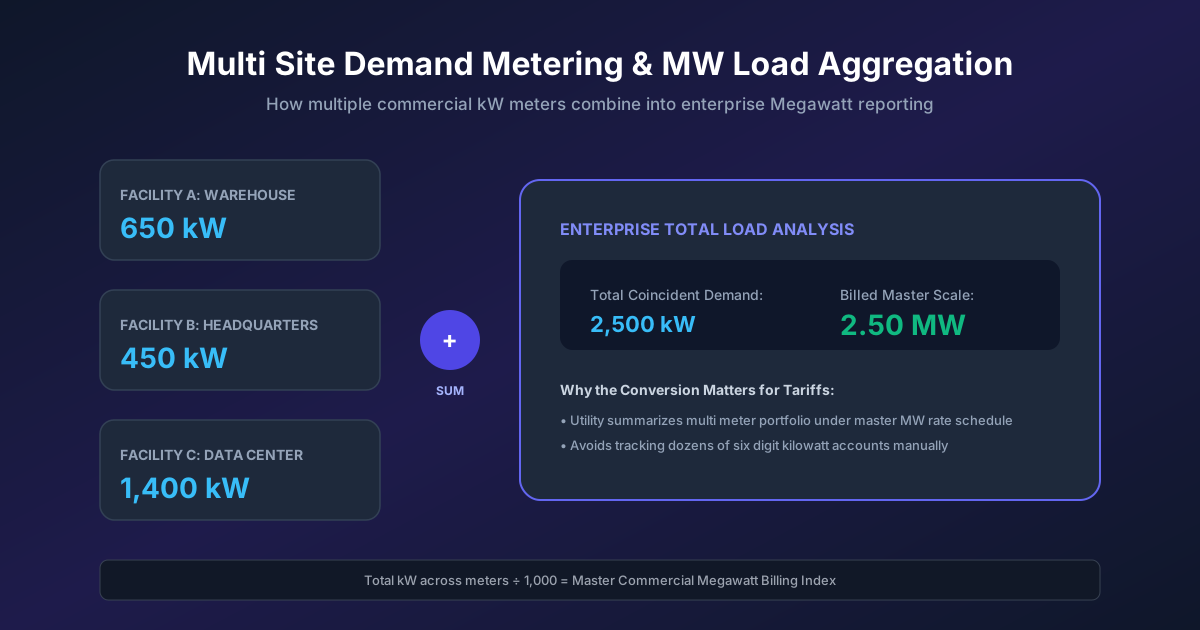
Large commercial and industrial customers often see demand charge calculations billed per kW of peak usage, but utilities frequently summarize total account load in MW once a customer’s commercial energy demand reaches several thousand kilowatts, especially across a multi-site account where individual meters each contribute to the total.
KW to MW in Backup Generator and BESS Sizing
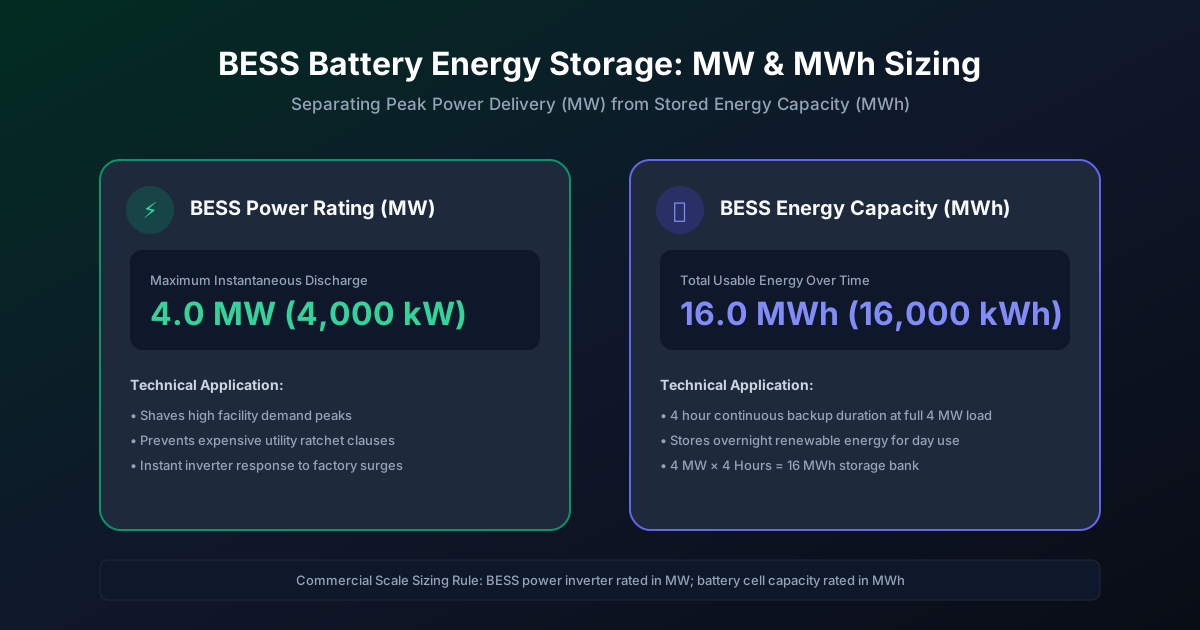
Backup generators for small sites are usually rated in kW, but a Battery Energy Storage System (BESS) supporting an entire campus or industrial power consumption load is commonly specified in MW and MWh, since the power and energy figures both reach commercial scale.
Grid Interconnection Applications That Require MW Reporting
Utilities and grid operators typically require projects above a set MW threshold to go through a more detailed grid interconnection study. Reporting capacity in MW at this stage is not optional; it is simply the unit the application process expects.
A Sample Calculation Across Different Facility Sizes
The table below shows how the same type of load calculation looks dramatically different in kW versus MW as a facility grows from a small store to a full manufacturing plant.
| Facility Type | Typical Load | Reporting Unit |
|---|---|---|
| Small retail store | 50 kW | kW |
| Office building | 400 kW | kW |
| Large shopping mall | 2,000 kW | MW (2 MW) |
| Industrial manufacturing plant | 15,000 kW | MW (15 MW) |
Notice how the reporting unit shifts naturally once demand passes the 1,000 kW mark, making MW the clearer choice from that point on.
Common Mistakes When Switching Between KW and MW
The most frequent error is mixing units within the same report, listing one facility in kW and another in MW without converting first. Another common mistake is confusing MW with MWh, since MW measures instantaneous power while MWh measures energy delivered over time, and the two are never interchangeable in a calculation.
Best Practices for Reporting Power Consistently
Pick a single unit for each report or dashboard, state clearly which unit is used, and convert every figure before comparing facilities of different sizes. This discipline prevents decimal errors that can misstate capacity by orders of magnitude, especially when figures get copied between spreadsheets and presentations.
Conclusion
Converting kW to MW in large-scale commercial power calculations matters most once a facility’s demand approaches 1,000 kW, where megawatt-scale reporting becomes the clearer, more practical unit. Whether you are sizing a BESS, filing a grid interconnection application, running a demand charge calculation, or simply building a commercial energy demand report, applying the kilowatt to megawatt conversion formula consistently keeps your numbers accurate and easy for everyone to read, from electrical engineers to non-technical stakeholders reviewing the same document, and it protects every downstream calculation that depends on getting the unit right the first time.
Need to convert electrical units right now?
Use our precision kW to MW, MW to GW, and kWh to MWh instant engineering calculators.