
Tracking a home solar array in kilowatts works fine until a project suddenly spans multiple buildings, a utility interconnection, or a grid-scale installation. The moment individual loads start adding up into the thousands, kilowatt figures turn into long strings of digits that are hard to read, compare, or report accurately. Since 1 megawatt equals 1,000 kilowatts, or 1,000,000 watts, switching units isn’t just a formatting preference, it reflects a genuine shift in project scale. Utility-scale solar farms, grid-level electricity production, and large commercial installations are measured in megawatts for good reason, while homes and small commercial systems stay comfortably in the kilowatt range. Knowing exactly when to make that switch saves time and prevents costly reporting errors down the line. This guide walks through the clearest signs that a project has outgrown kilowatt-scale thinking, and exactly when to make the switch to megawatts.
Why Kilowatt-Scale Thinking Breaks Down on Large Projects
Kilowatt-scale thinking works well for a single home or small commercial system, typically in the 5 to 15 kW range, but it breaks down once totals climb into the thousands. At that point, every kilowatt figure becomes a long, error-prone number that megawatt units were designed to simplify.
Signs Your Project Has Outgrown the kW Scale
A clear sign your project has outgrown kilowatts is when totals regularly exceed 1,000 kW, since that threshold is mathematically identical to 1 megawatt. Other signs include comparing your project against utility-scale solar farms or grid-level capacity figures, which are always reported in megawatts or gigawatts.
Load Aggregation: When Many Small Loads Add Up to Megawatts
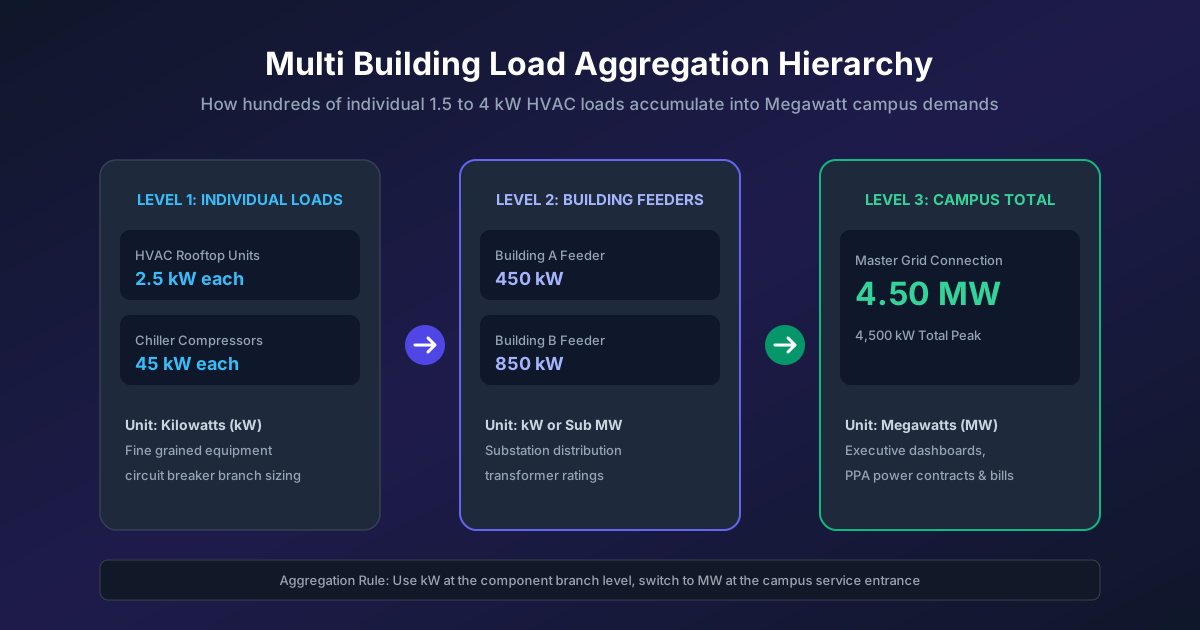
Individually small kilowatt loads, like HVAC systems rated around 1.5 to 4 kW each, can aggregate into megawatt totals once you’re managing dozens or hundreds of units across a commercial campus. Load aggregation is exactly where kilowatt-scale tracking quietly becomes impractical for accurate reporting.
Utility Interconnection Thresholds That Trigger an MW-Scale Mindset
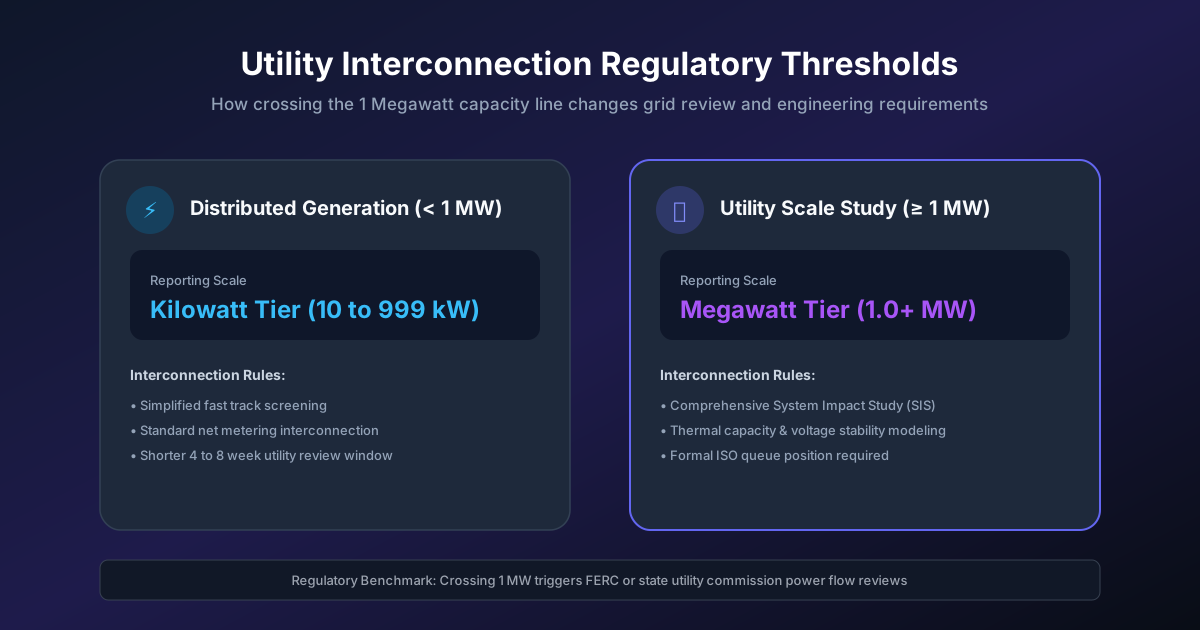
Utility interconnection agreements often set specific capacity thresholds, frequently measured in megawatts, that determine which regulatory review process a project must follow. Crossing one of these thresholds is a strong practical signal that megawatt-scale calculations are now the more accurate choice.
| Scale | Typical Use Case | Common Range |
|---|---|---|
| Kilowatts (kW) | Homes, small commercial systems | 5-15 kW |
| Megawatts (MW) | Large commercial, utility-scale, grid-level | 1-1,000 MW |
| Gigawatts (GW) | Statewide or national capacity | 1,000+ MW |
Capacity Planning for Commercial, Industrial, and Grid-Scale Projects
Capacity planning for commercial, industrial, or grid-scale projects almost always uses megawatts, since these figures get compared against state and national clean energy capacity benchmarks. The U.S. has already surpassed 150 gigawatts of installed solar capacity, a figure that would be unreadable in raw kilowatts.
Financial and Regulatory Reporting That Demands MW Units
Financial and regulatory reporting, including solar renewable energy credit programs, is typically structured around megawatt units, since one credit usually represents 1 MW of energy produced. Reporting in kilowatts at this scale would create unnecessarily long figures across every financial document and compliance filing.
Avoiding Decimal Clutter: Why MW Reads Cleaner at Scale
Converting kilowatts to megawatts is as simple as dividing by 1,000, and that single step instantly removes the decimal clutter that comes with tracking six- or seven-digit kilowatt figures. A clean number like 10 MW communicates scale far faster than 10,000 kW ever could in a report.
Mixed-Scale Projects: When to Report Both kW and MW Together
Some projects genuinely benefit from reporting both units together, especially when a site combines smaller kilowatt-rated equipment with an overall megawatt-scale output. Pairing both figures keeps individual component specs readable while still representing total project capacity accurately.
Common Mistakes When Scaling Calculations Up from kW to MW
A common mistake is forgetting to divide by exactly 1,000 when converting, which silently inflates or deflates a reported capacity figure by three orders of magnitude. Another mistake is mixing unit scales within the same report, confusing readers who expect consistent kilowatt or megawatt formatting throughout.
A Practical Threshold Guide for Switching Units
As a practical threshold, switch to megawatts once a project’s total capacity regularly exceeds 1,000 kW, or whenever you’re reporting figures for regulatory, financial, or grid-level purposes. Below that threshold, kilowatts remain the clearer, more practical choice for everyday calculations.
Conclusion
Switching from kilowatts to megawatts isn’t arbitrary, it reflects a real shift in project scale once totals cross the 1,000 kW threshold and keep climbing from there. Utility interconnection, financial reporting, and grid-level capacity all demand megawatt units for clarity, accuracy, and easier comparison across projects. Recognizing these signs early keeps your energy calculations clean, consistent, and appropriately scaled for the true size of every single project at hand.
Need to convert electrical units right now?
Use our precision kW to MW, MW to GW, and kWh to MWh instant engineering calculators.