
Staring at a solar quote or a utility bill full of unfamiliar abbreviations leaves most beginners guessing at what the numbers actually mean. Knowing when to reach for kilowatt to megawatt conversion math, versus when a kilowatt figure already tells the full story, saves real confusion down the line. The relationship between these units never changes, since every step follows the same fixed International System of Units rule. This guide breaks down exactly when each unit applies, how to convert between them, and where beginners typically trip up. Real examples from home solar systems and utility-scale farms make the scale difference concrete rather than abstract. By the end, choosing the right unit for any project becomes second nature.
Understanding the Basic Difference Between KW and MW
A megawatt is simply 1,000 times larger than a kilowatt, nothing more complicated than that. Grasping this single fixed ratio, part of the broader watt kilowatt megawatt gigawatt ladder, makes every later calculation far less intimidating.
This ladder keeps climbing beyond megawatts too, into gigawatts and terawatts for state-level and national electricity statistics, though beginners rarely need anything past the first two steps.
How to Convert Kilowatts into Megawatts Easily
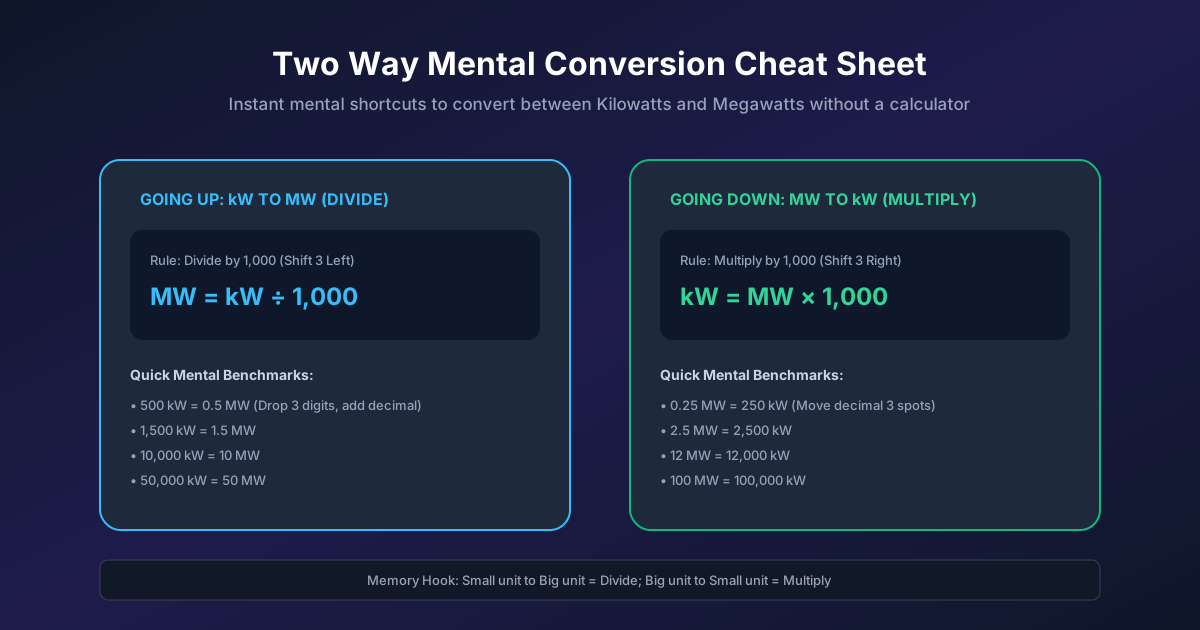
Converting in either direction takes one simple step. To divide kilowatts by 1000 for megawatts, or multiply megawatts by 1000 for kilowatts, covers every scenario beginners actually encounter on a bill or spec sheet.
| Input | Calculation | Result |
|---|---|---|
| 1,500 kW | 1,500 ÷ 1,000 | 1.5 MW |
| 5,000 kW | 5,000 ÷ 1,000 | 5 MW |
| 2 MW | 2 × 1,000 | 2,000 kW |
| 10 MW | 10 × 1,000 | 10,000 kW |
When Small-Scale Devices Should Use KW Ratings
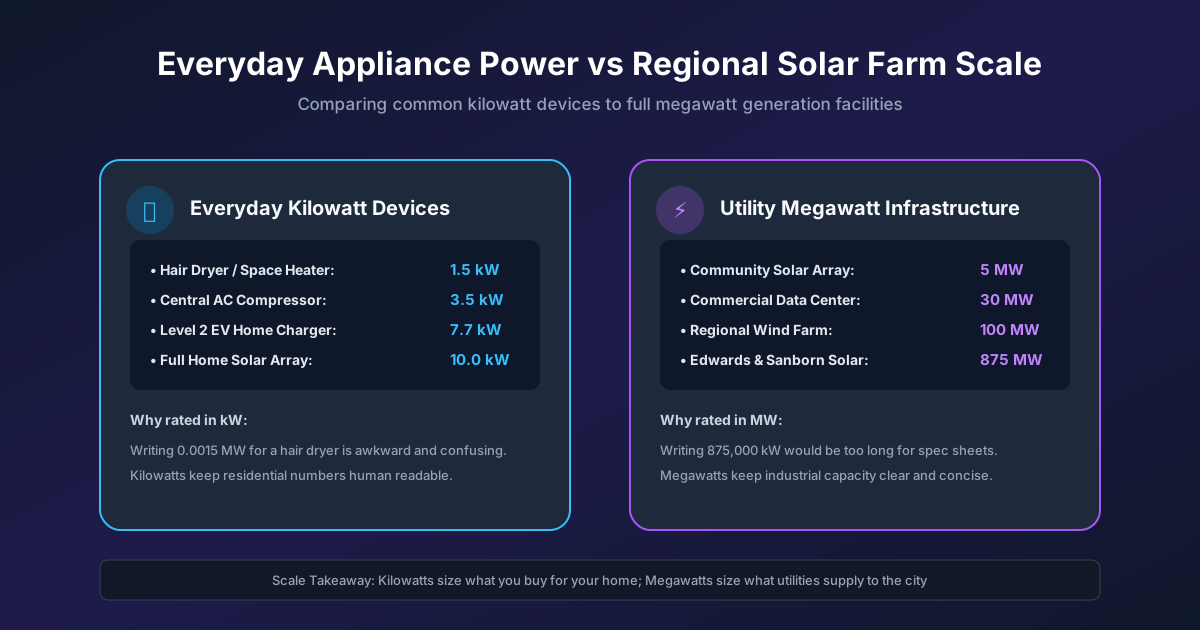
Household-sized equipment almost always stays within kilowatt territory. A rooftop solar system sizing project typically lands between 5 and 15 kW, a range small enough that megawatts would produce awkward, hard-to-read decimals.
Quoting a small system in megawatts would mean writing something like 0.008 MW, a figure far less intuitive than simply saying 8 kW on a homeowner’s paperwork.
When Large-Scale Systems Require MW Measurements
Once a project scales past a single property, kilowatts stop being practical. A utility-scale solar farm capacity measured in the hundreds of megawatts would require six-digit kilowatt figures that nobody wants to read on a report.
Common Mistakes Beginners Make With Power Units
Mixing up rate and total trips up nearly everyone at first. Confusing power rate vs energy total thinking, such as treating a megawatt capacity as an annual output figure, remains one of the most frequent beginner errors.
Moving the decimal the wrong direction causes a second common slip, since dividing feels less intuitive than multiplying when someone is working quickly through a spec sheet.
Real-World Examples Comparing KW and MW Usage
Concrete numbers make the scale gap obvious fast. A typical household appliance power rating, like a hair dryer drawing roughly 1.5 kW, looks nothing like the hundreds of megawatts a regional solar farm generates at full capacity.
How Power Plants and Grids Measure in MW
Grid-scale infrastructure demands a unit built for bigger numbers. Every grid-scale power measurement reported by utilities and regulators uses megawatts, since kilowatts would make national capacity reports unreadable at that scale.
Even gigawatts enter the conversation once an entire state’s installed solar capacity gets added together, which shows just how far the same simple ladder can stretch upward.
Why Household Appliances Are Rated in KW
Manufacturers choose kilowatts for a practical reason, not an arbitrary one. Keeping a commercial power system scale label out of a home appliance box keeps the printed number simple and genuinely meaningful to an average shopper.
Quick Conversion Formulas You Should Memorize
Two formulas cover essentially every situation a beginner will face. Remembering that MW equals kW divided by 1,000, and kW equals MW multiplied by 1,000, handles any conversion formula for electricity question instantly.
Choosing the Right Unit for Your Project or Calculation
Matching the unit to the project scale keeps numbers readable for everyone involved. A home system stays in kilowatts, a utility project stays in megawatts, and knowing that split prevents most beginner electricity conversion guide confusion for good.
Conclusion
Choosing between kilowatts and megawatts comes down to real project scale rather than complicated math most people already know instinctively. Home and appliance ratings stay in kilowatts, while utility and grid projects scale into megawatts purely for readability and convenience. Remembering the fixed thousand-to-one ratio, and which unit genuinely fits which project size, turns confusing spec sheets into numbers that actually make clear, confident sense immediately every single time now.
Need to convert electrical units right now?
Use our precision kW to MW, MW to GW, and kWh to MWh instant engineering calculators.