
Electrical work moves constantly between scales, which is why the kW to MW conversion appears in almost every project document. The relationship is fixed: one megawatt equals 1,000 kilowatts, or a million watts. Divide by a thousand going up, multiply by a thousand coming back down. Where it actually matters is in choosing the right unit for the right document, from an appliance rating to a grid-level capacity figure. Choosing badly makes a document harder to read and easier to misinterpret. Here are the points in a project where that conversion earns its place.
Reading the Nameplate Before Anything Else
Every piece of equipment carries a rated figure, and a watt simply describes the rate at which electricity is produced or consumed. A 100-watt bulb draws exactly 100 watts at any moment it happens to be switched on. Start from the nameplate figure, then convert, never the other way round.
Choosing the Right Unit for the Project Scale
Quoting a 6,000 W array sounds clumsy next to a 6 kW one, and a 10,000 kW farm reads far better as 10 MW. Panels themselves are usually priced per watt, which helps compare costs across sizes, but project documentation shifts to larger units purely for readability.
Which Unit Belongs in Which Document
| Project or equipment | Typical size | Unit normally used |
|---|---|---|
| Household HVAC system | 1.5 to 4 kW | Kilowatts |
| Residential solar array | 5 to 15 kW | Kilowatts |
| Small commercial system | Hundreds of kW | Kilowatts |
| Large commercial install | 1 to 10 MW | Megawatts |
| Utility-scale solar farm | 10 MW and above | Megawatts |
| Statewide capacity | 1,000 MW or more | Gigawatts |
Residential and Small Commercial Work in kW
Kilowatts dominate completely at this end of the scale. Household HVAC systems often sit between 1.5 and 4 kW, while residential solar arrays generally run from 5 kW to 15 kW. Converting these to megawatts produces awkward decimals that serve no practical purpose at all.
Utility-Scale and Grid-Level Work in MW
Megawatts take over for large commercial installations, utility-scale solar farms and grid-level production. Once a project passes a thousand kilowatts, the megawatt figure is what regulators, utilities and investors will expect to see in more or less every submission.
Going the Other Way: MW Back to kW
Detailed design work often needs the smaller unit back again. Multiply by a thousand, so that a 1.32 MW site becomes 1,320 kW. That conversion matters whenever you move from a headline capacity figure down to the level of individual arrays or individual circuits.
Sizing a System from Daily Consumption
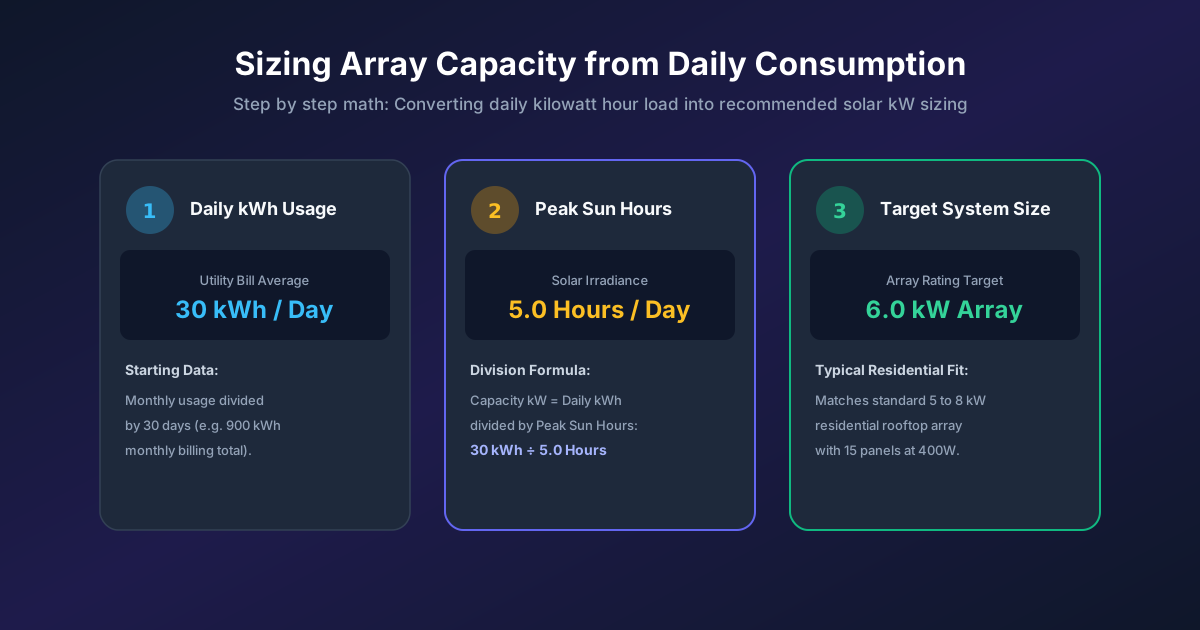
Sizing always starts from consumption rather than from capacity. Divide average daily use by the region’s peak sun hours: a household using 30 kWh daily with five peak sun hours indicates roughly a 6 kW system. That is precisely why so many homes land in the 5 to 8 kW range.
Power Versus Energy: kW and kWh
A kilowatt describes the power being used or created, while a kilowatt hour describes the power used across one hour. A 400 W rice cooker running twenty minutes consumes about a third of its hourly figure. Utility bills arrive in kWh precisely because billing tracks energy rather than power.
Reporting Installed Capacity and Fleet Totals
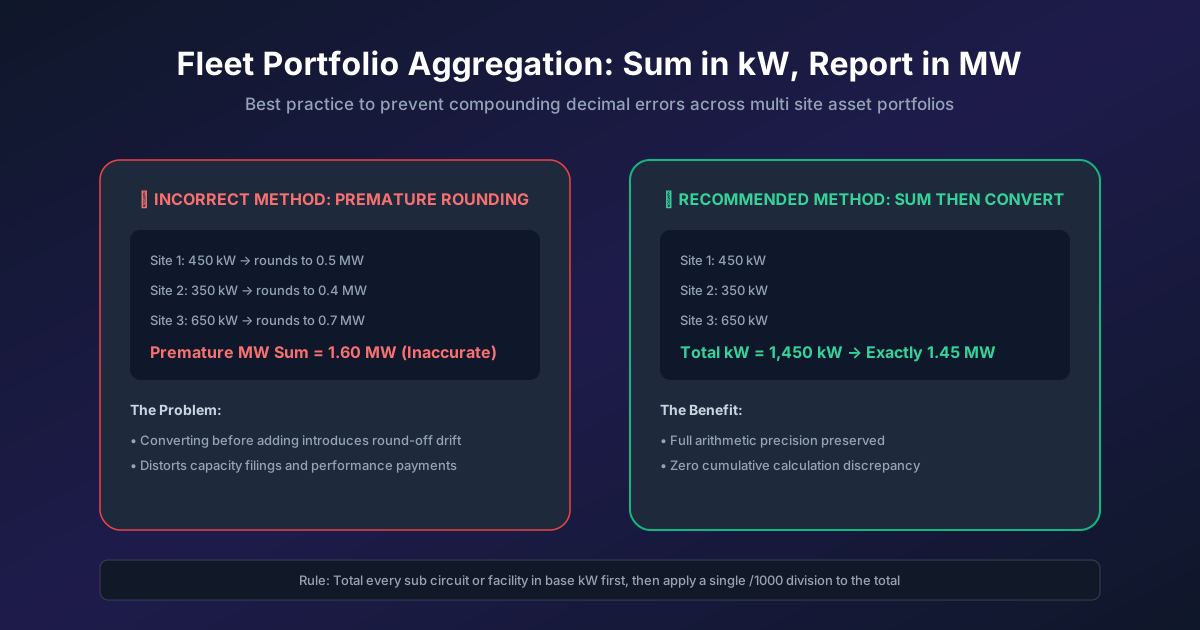
Portfolio reporting is where conversion errors tend to spread fastest. Total every individual site in kilowatts first, convert once, then present the combined figure in megawatts. National capacity reaches gigawatt territory, with the United States passing 150 GW of installed solar during the mid-2020s.
Renewable Energy Credits Paid per MW
Some performance payment programmes work entirely in megawatts. A solar renewable energy credit represents one MW of energy generated and typically carries a value of fifty to seventy-five dollars, so a system producing 10 MW across a year could return several hundred dollars.
Where the Decimal Point Costs Real Money
A figure of 0.1 MW and one of 0.01 MW differ tenfold, yet they look almost identical on a page. One gigawatt, meanwhile, equals 1,000 MW, enough capacity to power around 173,000 homes. Misplacing a single decimal in a capacity submission can misrepresent an entire project.
Conclusion
The conversion itself is trivial, yet knowing exactly where to apply it is what keeps your documentation clean. Use kilowatts for appliances, homes and small commercial sites, then switch to megawatts for large installations, grid submissions and credit programmes. Convert once on a combined total rather than site by site, keep your power and energy figures separate, and and check every decimal carefully before the number ever leaves your desk.
Need to convert electrical units right now?
Use our precision kW to MW, MW to GW, and kWh to MWh instant engineering calculators.