
Searching for a kW to MW converter usually turns up a flood of near-identical calculator pages, but the good ones share a specific set of features that separate a quick, trustworthy result from a vague or error-prone one. The best free tools convert instantly in the browser, show the exact formula and conversion factor used, and cover related units like horsepower, BTU per hour, and watts so you never need a second lookup. This guide explains exactly what to look for, where these tools typically live, and how to sanity-check any result yourself.
1. What to Look for in a Good kW-to-MW Converter Tool
A trustworthy converter displays the conversion factor it used, not just a bare number, so you can verify the math yourself. Look for tools that show the formula, such as MW = kW ÷ 1,000, alongside the result, support at least a dozen related power units, and process everything locally in your browser rather than sending your data to a server.
2. Browser-Based Calculators vs. Dedicated Conversion Apps
Simple browser-based calculators handle one-off conversions quickly and need no installation, making them ideal for a quick lookup during fieldwork or homework. Dedicated conversion apps add extras like saved history, CSV export, and preset shortcuts for common conversions, which matter more if you convert units daily rather than occasionally.
3. Tools That Handle Batch Conversions for Multiple Values at Once
Some free tools let you convert a whole list of values at once instead of one at a time, which matters when you are checking a spec sheet with dozens of entries, such as every panel rating on a solar farm design. A calculation history feature that stores recent entries, often the last 50 or more, serves a similar purpose for repeated single lookups.
4. Converters Built Into Engineering and Solar Design Software
Engineering and solar design software frequently includes built-in unit converters as a convenience feature alongside the main modeling tools, saving you from switching applications mid-project. These built-in converters are usually less flexible than a dedicated standalone tool, but they integrate directly with your working file, which can be faster for routine checks.
5. Mobile Apps for On-Site Conversions During Fieldwork
Mobile-friendly converter pages work well for on-site fieldwork, letting an electrician or HVAC technician check a kW to hp or TR to kW figure without opening a laptop. Look for a tool that loads quickly on mobile data and keeps its layout usable on a small screen, since cluttered desktop designs often break on phones.
6. Spreadsheet Formulas as a Free, No-Install Alternative
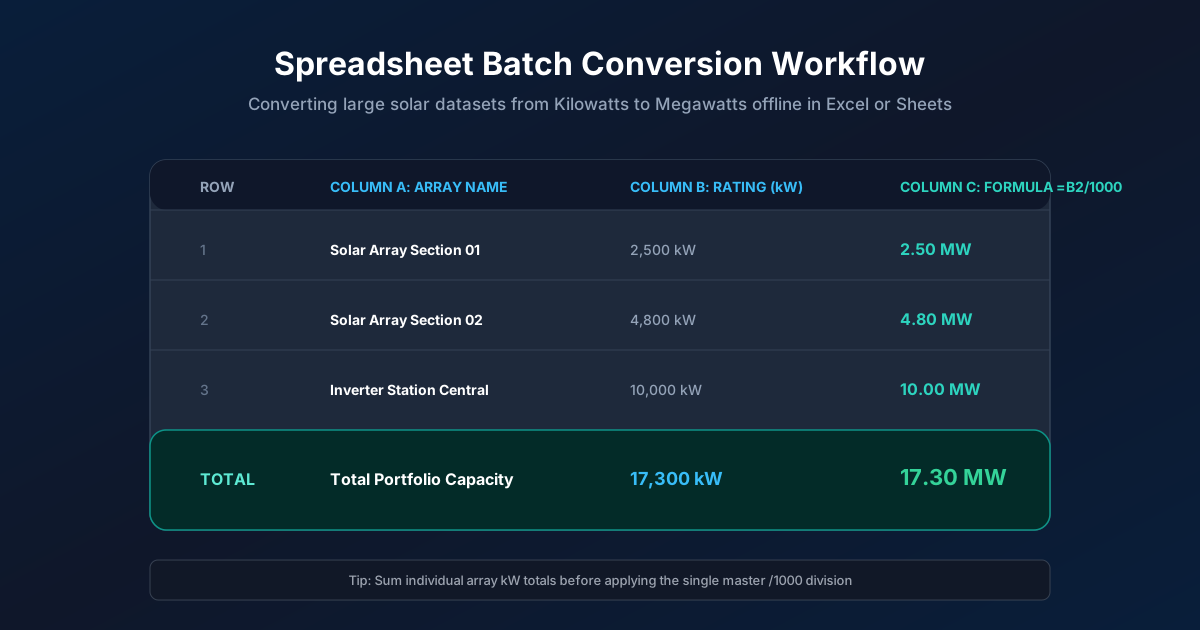
A spreadsheet formula is a free, no-install alternative that works entirely offline once set up: dividing a kilowatt column by 1,000 instantly produces megawatts for an entire dataset. This approach suits anyone who already works in spreadsheets for reporting and wants conversions built directly into existing project files rather than a separate tool.
7. Red Flags: Tools That Get the Decimal Point Wrong
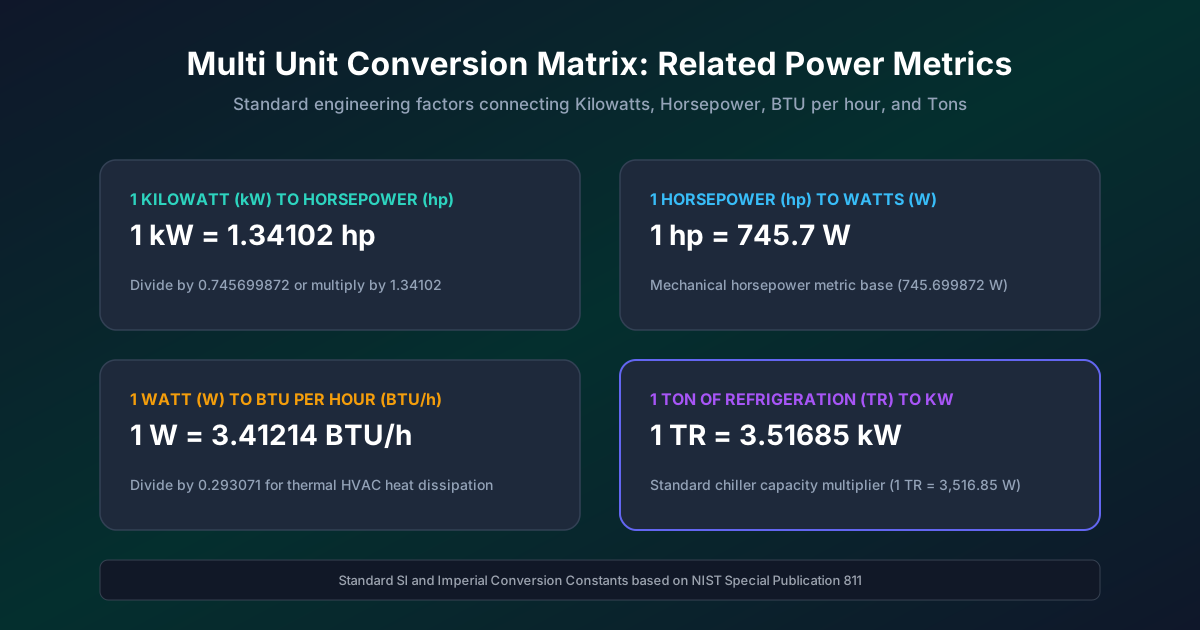
The clearest red flag is a tool that hides its formula or conversion factor, since you cannot verify whether it rounded correctly or used an outdated constant. A converter should show you that 1 kW equals exactly 1.34102 horsepower or that 1 watt equals 3.41214 BTU per hour, not just a final number with no explanation.
| Conversion | Factor | Result |
|---|---|---|
| 1 kW to hp | ÷ 0.745699872 | 1.34102 hp |
| 1 hp to W | x 745.699872 | 745.7 W |
| 1 MW to kW | x 1,000 | 1,000 kW |
| 1 W to BTU/h | ÷ 0.293071 | 3.41214 BTU/h |
| 1 TR to kW | x 3.51685 | 3.51685 kW |
8. Free Tools That Also Convert kWh to MWh and Watts to kW
The most useful free converters go beyond a single unit pair, also handling kilowatt-hours to megawatt-hours, watts to kilowatts, and gigawatts to megawatts within the same interface. A tool built around just one conversion forces you to find a second site the moment your spec sheet switches units, which defeats the purpose of a quick lookup.
9. Browser Extensions and Widgets for Quick Everyday Lookups
Browser extensions and bookmarklets can surface a quick conversion without opening a new tab, useful for anyone who converts units frequently while reading spec sheets or emails. These tend to support fewer units than a full calculator page, so they work best as a fast shortcut rather than a primary tool for detailed engineering work.
10. How to Double-Check Any Online Tool’s Result Yourself
Spot-check any online tool against a known reference: 1 megawatt should equal exactly 1,000 kilowatts, and 1 kilowatt should equal roughly 1.341 horsepower. If a tool’s result drifts from these fixed, well-documented values, treat its other conversions with suspicion and verify the underlying formula before trusting the number for real work.
Conclusion
The best free kW to MW converters share a few traits: they show their formula and conversion factor clearly, cover related units like horsepower and BTU per hour, and run entirely in your browser so results stay private. Whether you choose a browser-based calculator, a built-in design-software tool, or a simple spreadsheet formula, always spot-check the result against the fixed 1,000:1 ratio between kilowatts and megawatts before trusting the number.
Need to convert electrical units right now?
Use our precision kW to MW, MW to GW, and kWh to MWh instant engineering calculators.