
Knowing when to express a system in kilowatts (kW) versus megawatts (MW) is more than a style choice; it reflects the real scale of solar energy and industrial power grid projects. Since 1 MW equals exactly 1,000 kW, the conversion itself is simple, but choosing the right unit at the right project size keeps specifications, contracts, and grid data consistent. This guide walks through where each unit belongs and how to convert between them without error.
What KW and MW Actually Measure in a Power System
Both units measure power, the rate at which electricity is produced or consumed at a given moment, not the total energy delivered over time. A megawatt is simply 1,000 times larger than a kilowatt, since 1 MW equals 1,000,000 watts, and both scale linearly from the base unit of the watt.
Why Solar Installations Scale From KW to MW
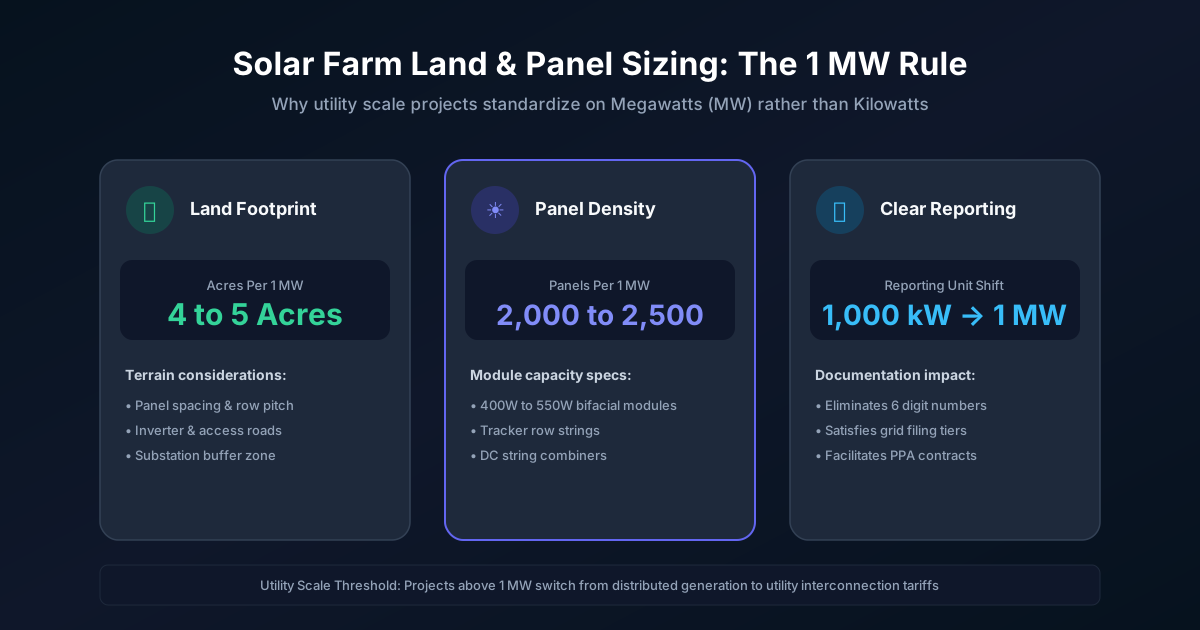
A residential solar system might be rated at 5, 10, or 15 kW, while a commercial project often sits around 500 kW. Once a project reaches utility scale, output is typically reported in MW, since describing a 20 MW farm in kilowatts would require an unwieldy six-digit number that offers little practical benefit on a spec sheet.
Residential and Commercial Solar: Where KW Still Applies
For homes and small businesses, kilowatts remain the practical unit, since system sizes stay well under 1 MW. Inverter ratings, panel wattage, and peak load demand are all easier to compare in kW at this scale.
Utility-Scale Solar Farms: Why MW Becomes the Standard Unit
A 1 MW solar farm generally covers 4 to 5 acres and needs roughly 2,000 to 2,500 panels depending on wattage. At this size, MW communicates capacity far more clearly than a kilowatt figure in the millions.
How Industrial Power Grids Report Capacity in MW
Power plants, industrial loads, and regional grids are described in MW or even gigawatts (GW), where 1 GW equals 1,000 MW. A single wind farm might produce 50 MW, while a national grid handles tens of gigawatts spread across many individual generating stations.
Converting KW to MW Accurately for Reporting and Contracts
The formula is straightforward: MW = kW ÷ 1,000, or kW = MW × 1,000. Getting this conversion right matters in contracts and grid connection applications, where a decimal point error can misstate capacity by three orders of magnitude and trigger the wrong regulatory review.
Common Mistakes When Mixing KW and MW in Grid Data
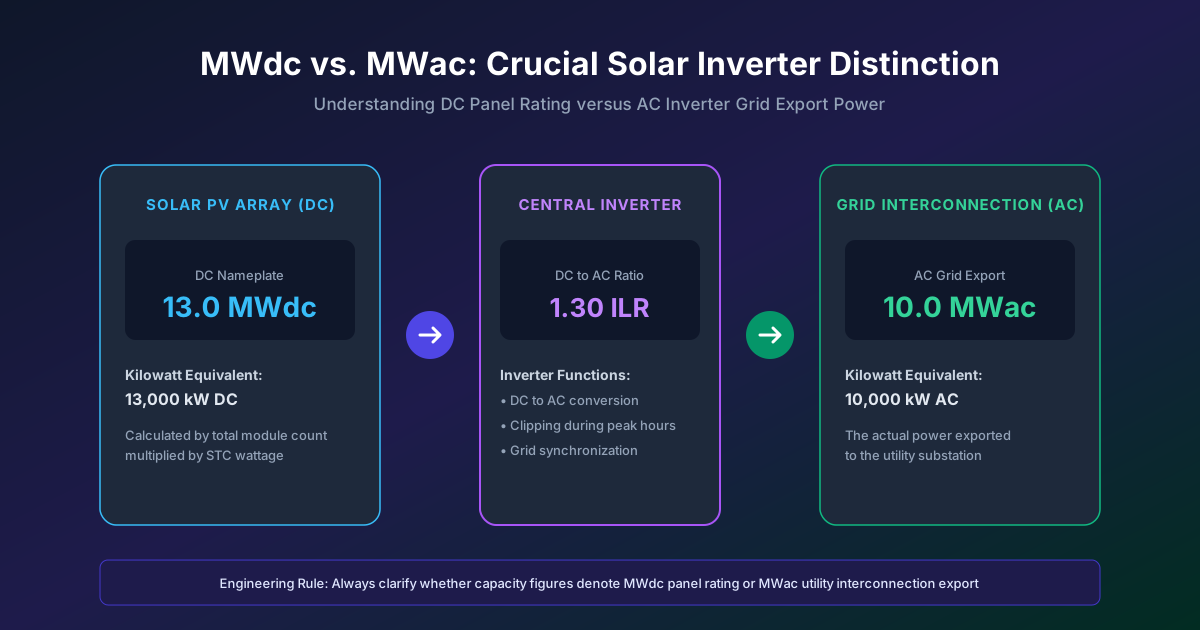
The most frequent error is confusing MW with MWh: MW is instantaneous power, while MWh includes a time component and measures energy delivered over an hour. Another common mistake is ignoring whether a solar rating is MWdc or MWac, since the DC panel rating and the AC inverter output are not the same number.
A Quick Reference Table for KW to MW Conversions
The table below shows how common solar and grid project sizes scale from kilowatts up through megawatts.
| MW | kW | W | Typical System |
|---|---|---|---|
| 0.1 MW | 100 kW | 100,000 W | Large commercial rooftop |
| 0.5 MW | 500 kW | 500,000 W | Commercial solar project |
| 1 MW | 1,000 kW | 1,000,000 W | Small utility-scale farm |
| 10 MW | 10,000 kW | 10,000,000 W | Mid-size solar farm |
As the table shows, the jump from commercial to utility scale is exactly where most projects switch their reporting unit from kW to MW.
How Grid Operators and Regulators Use MW Thresholds
Many jurisdictions set regulatory thresholds in MW to classify a project as utility-scale rather than distributed generation, triggering different interconnection rules, permitting timelines, and grid study requirements once a project crosses that line.
Best Practices for Engineers Working Across Both Scales
Always state whether a figure is MWdc or MWac, keep MW and MWh clearly separated in documentation, and convert to a single consistent unit before comparing systems from different vendors or project phases.
Conclusion
Choosing between kW and MW comes down to project scale: kilowatts suit homes and small commercial systems, while megawatts describe utility-scale solar farms and industrial power grids. Since the conversion is a simple factor of 1,000, the real discipline lies in keeping power and energy units separate and clearly labeled across every contract, report, and grid filing.
Need to convert electrical units right now?
Use our precision kW to MW, MW to GW, and kWh to MWh instant engineering calculators.